

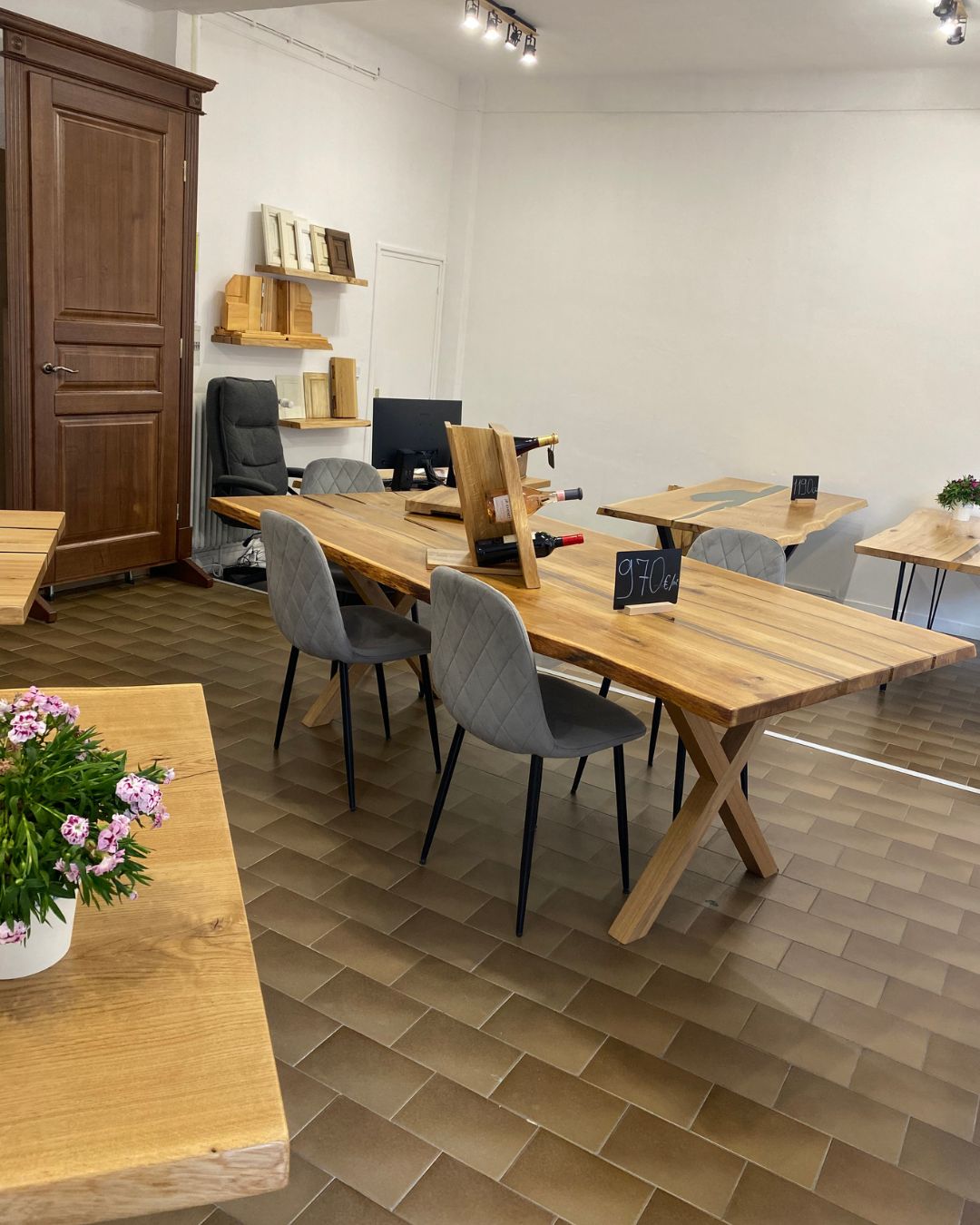
Solid wood tables with epoxy resin are becoming increasingly popular thanks to their unique design and natural character. But beyond aesthetics, what are their real advantages? Durability, maintenance, price, custom manufacturing: discover in this complete guide why these tables are an increasingly sought-after choice.
A solid wood epoxy table is not just a functional piece of furniture. It is a central element of the interior, capable of bringing character, warmth, and a true identity to a living space, dining room, office, or professional setting.
The uniqueness of a solid wood table with epoxy
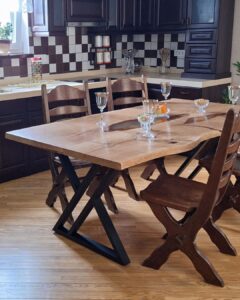 A solid wood table with epoxy resin is never an ordinary mass-produced piece of furniture. Each piece is unique because it comes directly from a piece of natural wood: a slab cut from the trunk of a tree, or sometimes several slabs assembled together.
Unlike industrial tabletops, the aim here is not to completely erase the traces of nature. On the contrary, these are often the details that give the furniture its full value: knots, cracks, color variations, wood grain, irregular edges that recall the bark, or even marks left by time.
The inner pattern of a tree never repeats itself. Even two boards from the same trunk will have a different appearance. This is what gives each table its own personal character. It can be elegant, raw, warm, modern, or spectacular, but it will never be identical to another.
Epoxy resin also makes it possible to highlight this uniqueness. It can emphasize a natural crack, fill a void, create a river effect between two pieces of wood, or simply stabilize an aged part of the tabletop. The result is a balance between the living material of wood and the precision of a contemporary material.
Buying a solid wood table with epoxy therefore does not simply mean buying a surface for eating or working. It means choosing a central piece for your interior, a piece of furniture that attracts attention, tells a story, and gives the room a true personality.
An ecological and responsible approach to wood
 Contrary to common belief, solid wood tables with epoxy resin can be part of an ecological and responsible approach. Their production often relies on a more complete and more respectful use of the raw material than in the standard furniture industry.
In conventional production, wood is cut, calibrated, and standardized. Parts considered imperfect, such as knots, cracks, or irregularities, are often removed. This leads to a significant loss of material.
By contrast, in the manufacture of solid wood tables, these natural elements are preserved and integrated into the final product. Almost every part of the board is therefore enhanced. What could be considered a defect becomes an aesthetic element and an important part of the table’s character.
In addition, the slabs used often come from old or large trees. This does not necessarily mean cutting down healthy forests, but often using wood from forest maintenance, naturally fallen trees, or trees felled as part of forest management.
An unmanaged forest can deteriorate: accumulation of dead wood, lack of light for young shoots, increased risk of fire. Using these trees therefore gives a second life to a resource that might otherwise be lost.
Transforming an old tree into a durable piece of furniture means extending its existence in another form. Finally, unlike low-cost furniture with a limited lifespan, a solid wood table is designed to last for many years, even decades.
This longevity reduces the need to replace furniture frequently, which lowers the overall environmental impact. Choosing a solid wood table with epoxy also means choosing a more durable object that enhances natural material and fits into a more responsible approach to consumption.
The role of epoxy resin: aesthetics and practicality
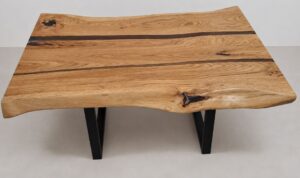 The use of epoxy resin in solid wood tables is not only an aesthetic choice, but also a practical solution that significantly improves everyday comfort of use.
Natural wood, especially when it comes to large old slabs, often has cracks, holes, fallen knots, or areas weakened by time. If these elements remain open, they quickly become problematic: dust, crumbs, or liquids can accumulate there, making cleaning difficult or even impossible.
Epoxy resin makes it possible to fill these irregularities while preserving their natural shape. It penetrates the cracks and stabilizes them, preventing them from developing over time. This prevents pieces of wood from coming loose, which could cause splinters or damage the surface.
In addition to this functional aspect, resin creates a more uniform surface that is pleasant to the touch and easy to maintain. The tabletop becomes more resistant to moisture and stains, which is particularly important for a table used every day, whether in a kitchen, dining room, or workspace.
Resin can also play an important aesthetic role. It can be transparent to highlight the structure of the wood, slightly tinted to emphasize certain contrasts, or used more boldly to create visual effects such as a river between two slabs.
Thus, epoxy resin is not simply a decorative element. It makes it possible to transform a natural, sometimes irregular material into a functional, durable surface suitable for everyday use, while preserving the authentic character of the wood.
Resin or wood: what balance should you choose?
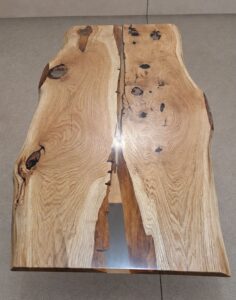 When designing a solid wood table, an essential question arises: how much space should epoxy resin take compared to the wood itself? There is no single right answer. It all depends on the desired result and the intended use.
Some tables are designed with a strong presence of resin. The wood is then partially or completely surrounded, or even covered. This type of creation emphasizes a very modern appearance, with clean lines and a perfectly smooth surface.
The visual effect can be spectacular, especially with deep colors or inclusions. However, the more dominant the resin is, the further the contact with the natural material moves away. The feel to the touch then becomes closer to that of a synthetic material.
Conversely, other tables give priority to wood. Resin is used in a targeted way, only to fill cracks, stabilize certain areas, or create a discreet river between two slabs. In this case, the surface remains mostly wood, with its warm and living touch.
The object retains a more authentic, almost raw appearance, while benefiting from the technical advantages of resin. From a practical point of view, surfaces that are mostly wood are often easier to maintain in the long term.
They can be sanded and renovated more easily in case of scratches or wear. Resin, although resistant, is generally more sensitive to visible micro-scratches and requires different maintenance. Tables completely covered with resin can also be more complex to repair.
The choice between a heavily resin-based table and a table that is mostly wood therefore depends on each person’s priorities: contemporary design and a strong visual effect, or natural contact and a timeless appearance.
In all cases, the goal remains the same: to find a harmonious balance between the living material of wood and the technical precision of resin, in order to create a piece that is aesthetic, functional, and durable.
Durability and longevity: an investment over time
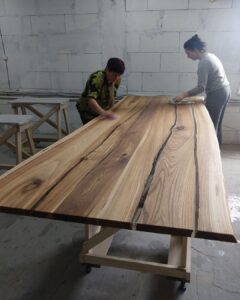 A solid wood table with epoxy resin is not designed as temporary furniture, but as a durable object capable of accompanying its owner for many years. This is one of its major advantages compared with standard furniture made from composite or industrial materials.
Solid wood, when properly dried and worked, is an extremely resistant material. It withstands everyday demands well: weight, light impacts, temperature variations. Unlike chipboard or laminate panels, it does not deform irreversibly and does not lose its strength over time.
Epoxy resin, for its part, reinforces the fragile areas of the wood. It stabilizes cracks, prevents them from spreading, and protects certain parts against moisture. The combination of these two materials creates a structure that is both strong and stable.
Another essential point is the possibility of renovation. Over time, a table may show signs of wear: micro-scratches, small stains, marks related to daily use. Unlike industrial furniture that often needs to be replaced, a solid wood table can be sanded, treated again with oil or varnish, and regain an appearance close to its original state.
Even resin can be polished to reduce certain scratches and restore shine to the surface. This considerably extends the lifespan of the furniture.
Investing in a solid wood table with epoxy therefore means choosing a product that does not quickly lose its value. On the contrary, over time, wood can evolve, develop a patina, and gain character, further enhancing its appeal.
Maintenance and everyday use
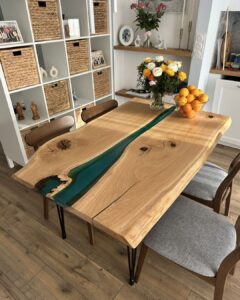 A solid wood table with epoxy resin is designed for everyday use, but like any natural material, it requires suitable maintenance to preserve its appearance and properties over time.
One of the main advantages of this type of table is its ease of maintenance. Thanks to epoxy resin, which fills cracks and irregularities, the surface is more homogeneous. Crumbs, liquids, or dust do not accumulate in hollow areas, making cleaning simple and quick.
A soft, slightly damp cloth is generally enough for regular maintenance. To preserve the surface, it is recommended to avoid direct contact with very hot objects, such as pots or dishes coming out of the oven.
Using trivets is a simple habit that helps prevent heat marks, especially on resin areas. As for the wood, if it is treated with natural oil, it may require periodic maintenance.
Applying oil once or twice a year helps nourish the wood, revive its color, and strengthen its protection against moisture.
Epoxy resin, although resistant, may develop fine micro-scratches over time, especially with intensive use. To limit them, it is advisable to use placemats or protections for abrasive objects. If necessary, the resin surface can be repolished to restore its original appearance.
It is also preferable to avoid aggressive chemical products, which could damage the wood or dull the resin. Mild and suitable products are more than sufficient.
By following these few simple rules, a solid wood table with epoxy will retain its aesthetics and functionality for a long time, while remaining pleasant to use every day.
Why do these tables cost more?
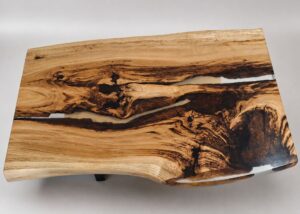 The price of a solid wood table with epoxy resin may seem high at first, especially compared with standard furniture available from large retailers. However, this difference is explained by several essential factors related to the material, production time, and artisanal work.
First of all, the raw material itself has significant value. Solid wood slabs, especially wide and high-quality ones, are rare. They must be carefully selected and often dried for a long period to prevent future deformation. This process can take several months, or even several years.
Next, the production of such a table is not done in series. Each piece is worked individually: wood preparation, cleaning cracks, shaping, creating molds for the resin, pouring, curing, sanding, polishing, and finishing.
Each stage requires time, precision, and experience. Epoxy resin itself is a technical material that requires specific application conditions. Poor implementation can lead to visible defects or weaken the structure.
Working with resin therefore requires particular know-how. Personalization must also be taken into account. Unlike standard furniture, a solid wood table with epoxy can be made to measure: dimensions, shape, type of wood, resin color, type of finish.
This adaptation to the client’s needs is an integral part of the product’s value. Finally, it is important to consider lifespan. Low-cost furniture often has to be replaced after a few years. By contrast, a well-made solid wood table can last for decades, be maintained, and even restored.
In the long term, the investment therefore becomes more rational. Thus, the price reflects not only the cost of materials and labor, but also the quality, durability, and uniqueness of the product.
Custom-made: furniture adapted to your interior
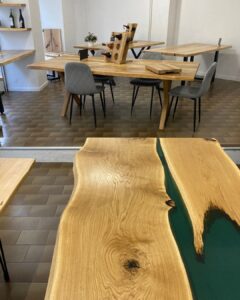 One of the great advantages of solid wood tables with epoxy resin is the possibility of creating a completely personalized piece of furniture. Unlike standard products manufactured in fixed dimensions, these tables can be precisely adapted to the needs and constraints of each interior.
Each project generally begins with the choice of wood. Species, color, structure, presence of knots or cracks: all these elements influence the final result. Some clients prefer light and uniform wood, while others instead look for a more pronounced appearance, with strong contrasts and visible texture.
Shape and dimensions also play an essential role. Dining table, desk, coffee table, or meeting table: each use requires different proportions. It is possible to adjust the length, width, and thickness of the tabletop, but also to work with more original shapes: natural edges, softened corners, or asymmetrical compositions.
Epoxy resin also offers many possibilities for customization. It can be completely transparent to let the wood take center stage, slightly tinted to enhance certain effects, or used more expressively with deep colors.
The river effect is one of the best-known options, but there are many variations depending on taste. The choice of legs completes the design. Metal, wood, industrial shapes, or more discreet forms: this detail strongly influences the overall style of the furniture.
Finally, the finish — whether oil, varnish, matte, or satin — makes it possible to adjust the final appearance and the feel of the surface.
A custom-made table is therefore not just a functional object. It is a project adapted to a specific space, a concrete use, and a personal aesthetic vision. It becomes a central piece of the interior, designed down to the smallest detail.
Conclusion: a unique, durable table adapted to your space
Choosing a solid wood table with epoxy resin means choosing a unique, durable piece of furniture adapted to your space. Between natural aesthetics and modern technology, these tables offer a rare balance that makes them much more than a simple piece of furniture.
Each tabletop tells a different story. Wood brings its warmth, grain, irregularities, and authenticity. Epoxy resin makes it possible to stabilize, protect, and highlight this natural material while opening up many creative possibilities.
Whether it is a wood river table, a custom epoxy table, a natural wood design table, or a more understated piece centered on solid wood, the choice depends above all on your interior, your use, and your aesthetic preferences.
At Bois & Âme, we create solid wood and epoxy resin tables designed to last, adapt to your space, and reflect your style.